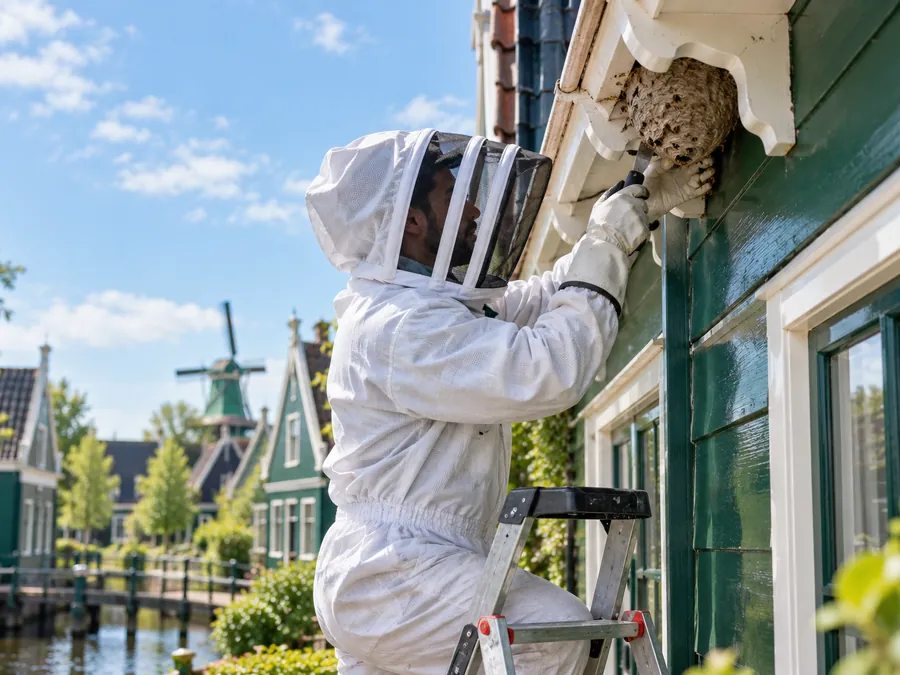

Wasp nest removal in Zaandam: spotting a nest early
Every nest starts small. In spring a lone queen builds a grey ball of chewed wood fibre, roughly the size of a table-tennis ball, and once her first workers hatch it grows quickly. Wasps want a dry, sheltered void with a narrow entrance: a cavity wall, the space beneath roof tiles, a roller-shutter box or a garden shed. Signs to watch for:
- wasps repeatedly vanishing at the same point, such as a gap, an air brick or a loose tile;
- a faint crackling or rustling inside a wall, ceiling or shed panel;
- a papery grey globe in a shed, a hedge or under the eaves.
The sooner you find it, the smaller the colony and the simpler the job.
How we deal with a wasp nest
A nest tucked away at the far end of the garden can often be left alone. Next to the front door, a play area or the patio, or inside the house, it is wiser to act, especially if anyone at home is allergic to stings. At the inspection we identify the species and find the entrance hole. Treatment ideally takes place in the evening, when nearly the whole colony is home. Wearing protective clothing, we apply a professional product at the entrance, and the wasps carry it deeper into the nest as they come and go.
A nest deep inside a cavity wall is normally left in place; it dries out and will not be used again. As with all our pest control in Zaandam, you get advice afterwards on sealing gaps, so you are less likely to need wasp nest removal again next year.
Bee nest removal in Zaandam
Not every buzzing colony belongs to wasps. Honey bees are brownish and hairy; wasps are glossy yellow and black with a narrow waist. We do not kill honey bees. If a swarm is hanging like a bunch of grapes from a branch or fence, or a colony has moved into a chimney or cavity, the best solution is to have a beekeeper (imker) collect or relocate it.
Bumblebees are best left in peace where possible: their colonies are small and die off at the end of the season. Tiny bees crawling into old mortar joints are generally harmless mason bees. Not sure what you are looking at? We can tell you at the inspection, and advise whether a bee nest really needs to go.
Hornet nest removal in Zaandam
Two hornet species live in the Netherlands. The European hornet is large, reddish-brown and yellow, and nests in hollow trees, bird boxes, sheds and lofts. It also flies at dusk and is drawn to lit windows. If such a nest is in an awkward spot, we can remove it.
The Asian hornet (Aziatische hoornaar) is an invasive species with a dark, almost black body, a single orange band near the tip of its abdomen and yellow legs. Early in the year the queen often starts a small nest under a porch roof or in a shed; by late summer the main nest usually hangs high up in a tree. Log any sighting at waarneming.nl and stay well back. Never try to tackle a hornet nest yourself – it takes protective gear and the right equipment.
What not to do with a wasp nest
In a panic, people sometimes reach for things that only make matters worse. Please avoid:
- spraying a can of insecticide into the entrance, which simply makes the colony aggressive;
- sealing or taping over the hole, as the wasps will look for another way out, sometimes into your home;
- poking the nest with a stick or broom to knock it down;
- using water, petrol or fire, particularly near a timber house.
Found droppings or gnaw marks in the same shed? We can look at those during the inspection too; read more about rat control.